Pichón Invaders
A game that started in 2013 as a Space Invaders-inspired experiment controlled with a webcam and physical markers, revisited and expanded more than a decade later. Today it is a modern arcade project for the browser, and the camera is back as a way to play.
Origin: 2013
In 2013 I built the first version, a Space Invaders-inspired game in C#, during “Videogames for Windows 8”, a 60-hour Microsoft Learning workshop.
It was early game-development work and, above all, an experiment in alternative input: the game was not played with a keyboard but with a webcam.
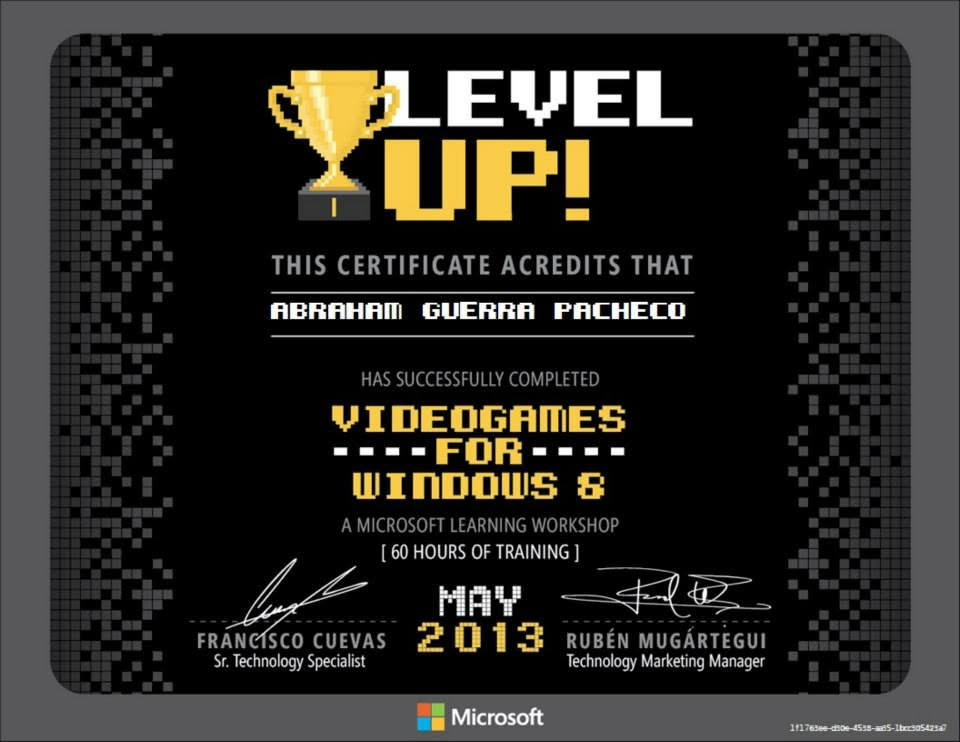
Original interaction
The webcam recognized physical markers and textures as references: each one meant a direction (left, right, up or down), and a separate interaction fired.
It was simple recognition of known references, not sophisticated computer vision, and it was built years before AI coding assistants existed.
Revisited and expanded
More than a decade later I revisited the project and expanded it into Pichón Invaders: web technologies, modern controls, and more depth in gameplay, visuals and engineering.
The original interaction experiment evolved into the current project. Camera mode tracks the player’s hand and fires with a pinch gesture: the same idea of playing without a keyboard, built with today’s tools.
The goal was to keep the original’s identity and arcade spirit while taking it to a modern implementation.
Evolution
What changed, and what remained
| Aspect | 2013 | Today |
|---|---|---|
| Platform | C# application | The browser: plain JavaScript and Canvas 2D, with no framework or build step |
| Controls | A webcam reading physical markers for four directions, plus a fire interaction | Keyboard, touch, device tilt, camera hand tracking with a pinch to fire, and a gamepad or a phone as a controller |
| Game | A Space Invaders-style experiment | Ten levels, two bosses, three difficulty levels, power-ups and a global leaderboard |
What remained
- The arcade core: a ship on the left shooting at invaders coming from the right.
- The camera as a way to play. In 2013 it read physical markers; today it tracks the player’s hand.
- The Yeti on level 6 and the robot as the final boss, both carried over from the 2013 version.
- The name: “Pichon” was the player name in the 2013 version.
Current project
- A classic mode with ten levels: a Yeti boss on level 6 and a final robot on level 10 with a second phase.
- Three difficulty levels that scale the number of enemies.
- Power-ups (triple shot, power shot and shield), and pichones: helmeted pilots who eject from destroyed invaders and can be caught for extra points.
- Five ways to play, chosen before each game: keyboard, touch controls, tilting the device, camera hand tracking, and a gamepad or a phone paired as a controller with a QR code.
- A global top-10 leaderboard.
- Designed for landscape screens, with a portrait option; rotating the device pauses the game instead of restarting it.
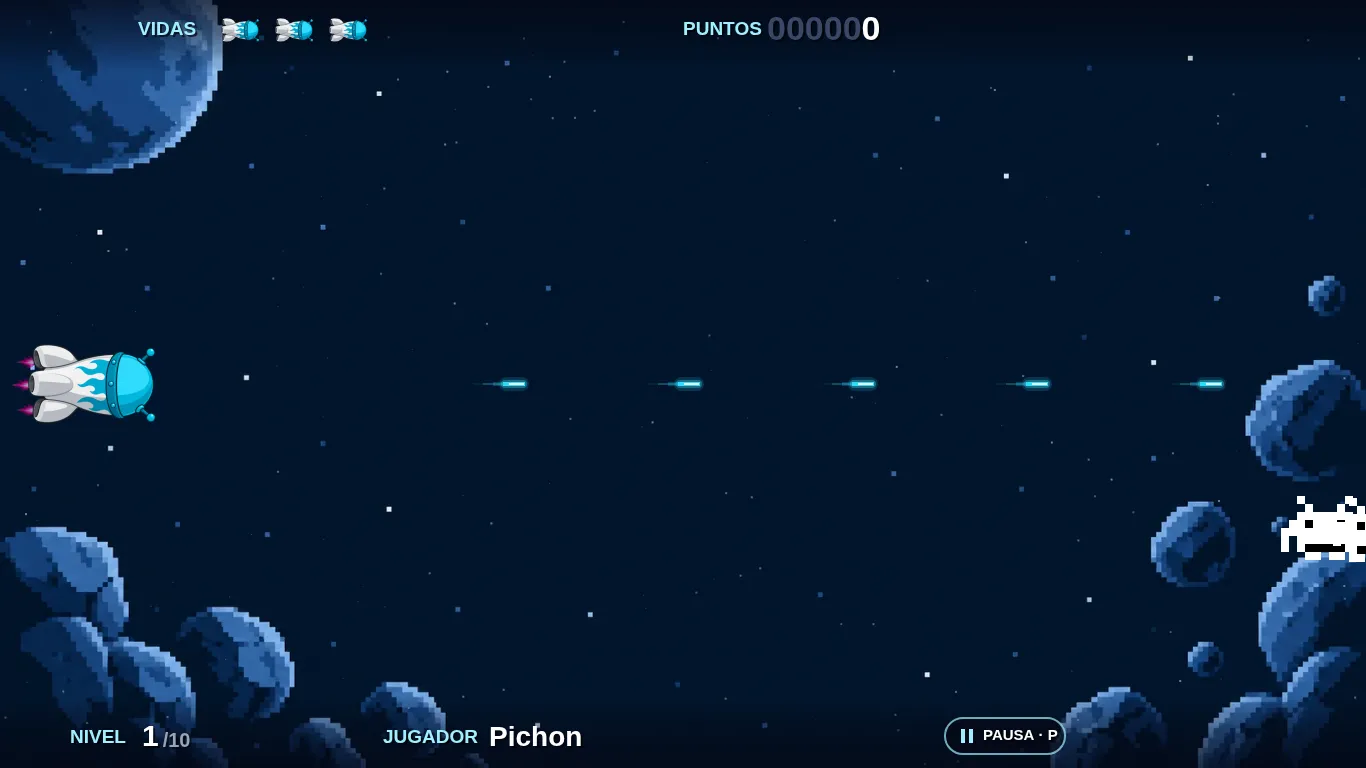
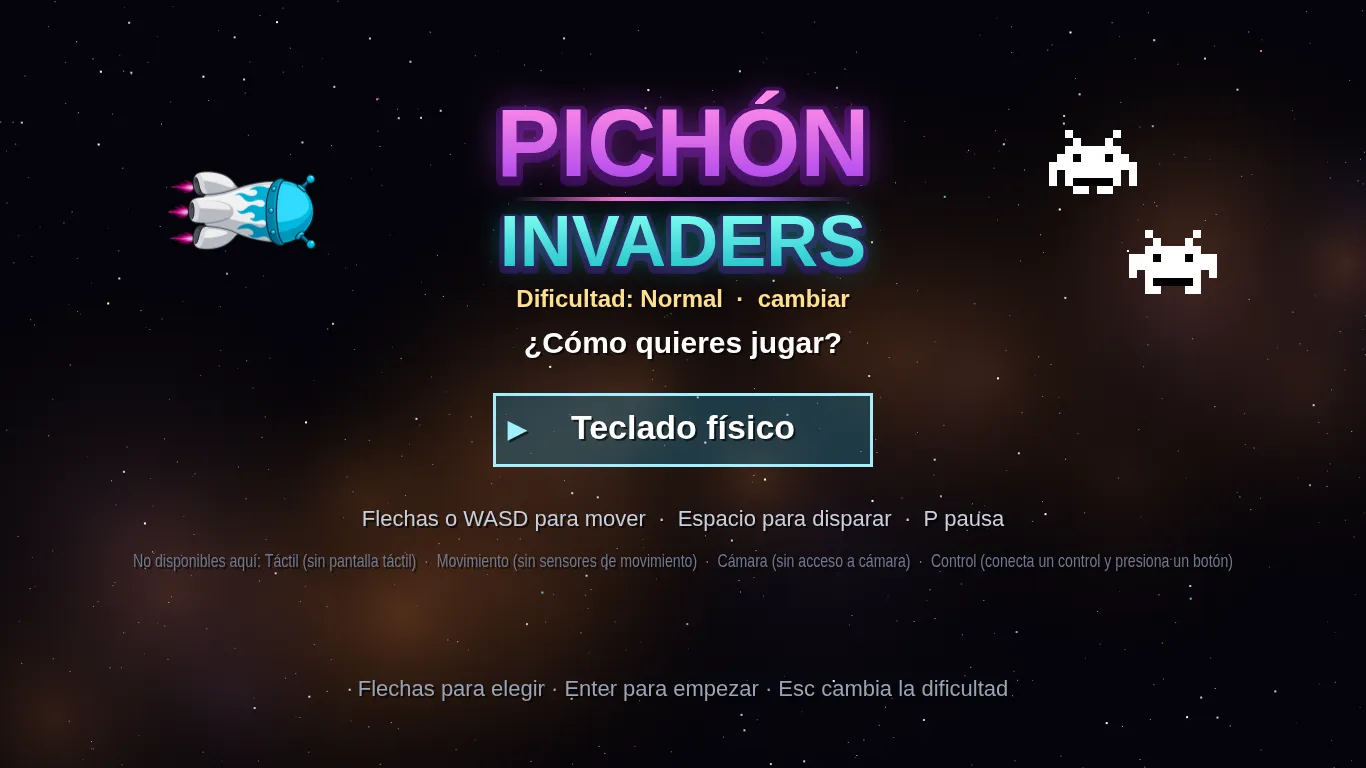
Captured from a local run of the current build.
Technical evolution
- Plain JavaScript with native ES modules and Canvas 2D: no framework, no build step and no runtime dependencies.
- A fixed 60 Hz simulation step and a scene stack, at a 1366 × 768 logical resolution.
- Camera mode runs MediaPipe hand tracking in a Web Worker and is loaded only when chosen. No video is stored.
- Phone-as-controller input travels over WebSockets through a relay built on a Cloudflare Durable Object.
- The leaderboard and anonymous analytics run on Cloudflare Pages Functions and D1.
- An automated test suite on Node’s built-in test runner, including tests against the real database migrations.
Process
The 2013 sources were no longer available, so nothing was ported: screenshots of the original served as the visual reference. The design plan labels each decision as confirmed from the original, inferred from it, or newly proposed, so the game is clear about what it keeps and what it adds.
Live project
Pichón Invaders is playable in the browser. It is designed for landscape screens; on a phone it suggests rotating and also offers a portrait mode.
pichoninvaders.abrahamguerra.dev